The concept of "algebra of functions" is in essence the "arithmetic" of functions, as it works with adding , subtracting, multiplying and dividing functions.
On the non-
CAS calculator, we will be working numerically and graphically
(but not performing symbolic algebraic manipulation such as simplifying variables or expanding expressions).
First, let's look at working numerically.
| 1. |
Given the functions f (x) = x2 - 9 and g(x) = 2x + 5, evaluate when x = 6:
a) f (x) + g(x)
b) f (x) - g(x)
c) f (x) • g(x)
d) f (x) / g(x) |
| |
Since we are doing repetitions of the functions, we will start by defining the functions for our use.
Open a new Calculator page.
Define the two functions:
 , Actions, Define , Actions, Define
Enter function f (x): Define f (x) = x2 - 9
Repeat the define process for function g(x).
Now, simply type the combined expression you need and press  . .
Repeat the process for each expression.
Remember that "defined functions" can be "called up" by pressing the  key. key. |
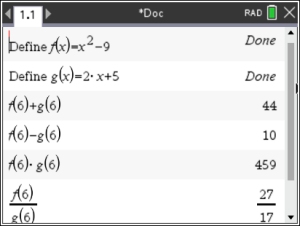
Defined function "letters" will appear in bold.
Be sure to exit a set of parentheses before continuing to the second function. |
Working graphically:
Display the graphs of the four algebraic functions created above (example 1).
| 2. |
Functions f (x) = x2 - 9 and g(x) = 2x + 5 have been defined in Example 1. Using those defined functions, graph:
a) f (x) + g(x)
b) f (x) - g(x)
c) f (x) • g(x)
d) f (x) / g(x)
Remember that the functions' names are available under the key.
Look at your graphs to see if they are what you would expect from combining the two functions.
|
| |
On a Graph page: f1(x) = f (x) + g(x)
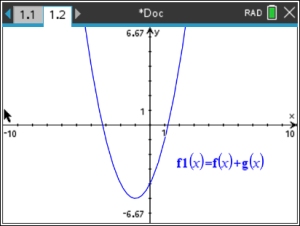
A quadratic added to a linear leaves a function with the largest power being two, another quadratic.
|
f1(x) = f (x) - g(x)
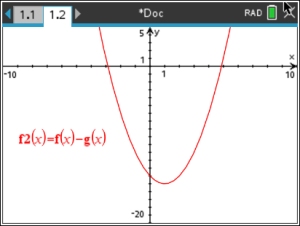
A linear subtracted from a quadratic leaves a function with the largest power being two, another quadratic.
|
| |
f1(x) = f (x) • g(x)
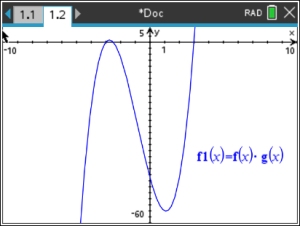
A quadratic multiplied by a linear creates the largest power to be a power of three, a cubic function. |
f1(x) = f (x) / g(x)
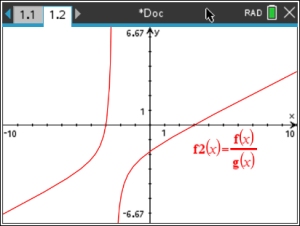
A problem involving division cannot allow division by zero, so the graph is undefined when g(x) = 0 which is at x = -2½. |
|